How catastrophes impact access to food
Food production
The loss of agriculture, even in just one region of the world, would increase costs and impact access to food for people everywhere.
A global catastrophe that reduces sunlight and decreases global temperature is what we call an Abrupt Sunlight Reduction Scenario (ASRS). These events could include nuclear winter, a supervolcanic eruption, or an asteroid/comet impact. An ASRS could gravely affect our capacity to grow food through traditional agricultural means. For example, a nuclear war could cause a loss of up to ~90% of global food production.
Supply chain and distribution
Food is dependent on global collaboration, with many countries relying on importing and exporting grains, produce, and other items to feed their people.
Catastrophes that affect energy and other infrastructure, risking a Global Catastrophic Infrastructure Loss (GCIL) – coordinated cyberattack, an extreme solar storm, a high-altitude electromagnetic pulse (from a nuclear attack), or an extreme pandemic causing fear in workers – could take electrical grids offline, which would disrupt food supply chains, shipping, and distribution management.
Other events, such as non-nuclear world war, could disable ports and other distribution channels.
Equitable access
Famines often occur not because of a lack of food, but because those most in need of food can’t access it, often for financial or political reasons.
A global disaster, regardless of whether it impacts food production, the supply chain, or both, could exacerbate this if wealthier countries and people hoard food for themselves, while poorer countries and people are priced out.
To save the most lives after a catastrophe, ALLFED identifies resilient foods and other solutions that are affordable to help maximize the number of people fed and the access to the nutrition they need to survive a catastrophe.
Four categories of catastrophes affecting food production
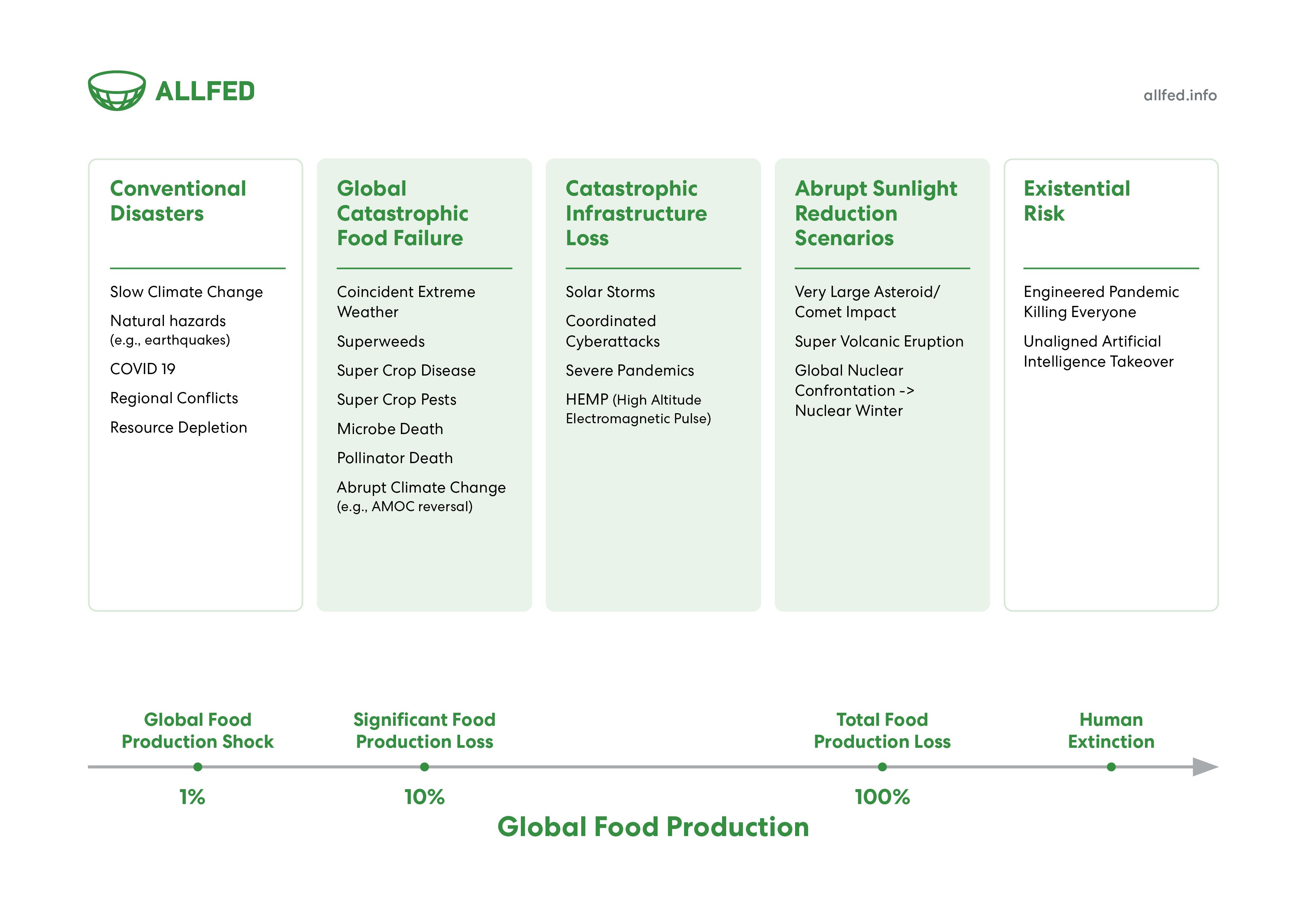
ALLFED recognizes four categories of catastrophes that have the potential to lead to a 5% loss in global calorie output. Different categories of catastrophes overlap to some extent, and this potential for interaction between catastrophes could make each of them more likely, and more harmful.
For a visual representation, have a look at our Global Catastrophic Risks (GCR) overview and risk timeline.
- Catastrophic Infrastructure Loss
- Multiple breadbasket failure
- Systemic, cascading, and compound risks
- Unknowns
Catastrophic Infrastructure Loss
Technology is the main reason society has advanced and progressed as much as it has. Yet, many of our innovations have also created new vulnerabilities.
Infrastructure, especially that which supports the electrical grid and fossil fuel production, enables nearly everything we do. Modern civilization quite literally depends on this infrastructure to function. But this dependency makes us vulnerable to several types of natural and technological threats.
These come under the umbrella of Global Catastrophic Infrastructure Loss (GCIL) and include
- High-altitude electromagnetic pulses (HEMPs) caused by nuclear attacks
- Natural or engineered pandemics, which, if deadly enough, could prevent essential workers from operating critical infrastructure.
- Cyberattacks, an increasing risk, especially as artificial intelligence (AI) programs become more powerful.
Cyberspace is especially vulnerable, as hackers have already successfully targeted government agencies, oil pipelines, and even electrical grids. So far, these attacks have been small in scale compared to the catastrophes ALLFED focuses on; however, as computing and AI grow more powerful, hackers could potentially cause massive disruptions to critical infrastructure systems, such as those needed to transport or safely store food and water.
Some threats could even impact humans more directly, whether via an intentional biological attack (such as bioterrorism or biowarfare), or an accident (such as a biological lab leak of deadly pathogens).
Multiple breadbasket failure
Multiple Breadbasket Failure (MBBF) occurs when several major farming regions, known as 'breadbaskets', experience large-scale crop failures simultaneously. These regions, such as key grain-growing regions or agricultural hubs, are critical for global food production and their simultaneous failure would pose a serious global risk.
Global warming driven by human activities increases the likelihood of severe weather events happening at the same time across these key farming areas. This would greatly reduce crop yields, lead to sharp rises in food prices, and worsen global food insecurity. An ASRS (from e.g. nuclear war or volcanic eruption) or GCIL (from e.g. nuclear EMP or cyberattack) could also result in an MBBF.
Systemic, cascading, and compound risks
Perhaps the greatest threat we face isn’t one of the catastrophes listed here, but a combination of such threats.
We live in a complex, interconnected world with many vulnerabilities, and disasters can negatively affect multiple aspects of our systems.
For example, though extreme solar storms, such as the Carrington Event in 1859, are unlikely to cause GCIL directly, they could cause widespread temporary electrical outages, which could cascade into additional consequences.
Unknowns
We’ve identified and studied many threats that could result in catastrophic infrastructure loss or multiple breadbasket failure.
However, even for anticipated threats with potential for mass scale global disruption, such as nuclear attacks, pandemics, cyberattacks, or solar storms, their likelihood of materializing and resulting in a global catastrophe is still unclear.
And, of course, there are unknown unknowns.
A large number of the catastrophes that we know about now were only recognized in the last few decades. This indicates there could be many more risks to global food systems and critical infrastructure we’re simply not aware of yet.
While it’s important to try to identify as many threats as possible, it’s just as critical to understand how risks could impact key societal functions, so that we can build resilience into our global systems and be ready for any disaster.